
The Bylaw approves a 0% net increase in the municipal portion of residential property taxes while maintaining a non-residential property tax rate of $10 for every $1,000 in assessed value.
--
During its May 19, 2026, Regular Council Meeting, Coaldale Town Council approved the Town’s 2026 Property Tax Bylaw.
In keeping with direction provided by Council during the 2026–2028 budget process, the Bylaw approves a 0% net increase in the municipal portion of residential property taxes while maintaining a non-residential property tax rate of $10 for every $1,000 in assessed value.
To achieve a 0% net increase in the municipal portion of residential property taxes, Council lowered the residential mill rate from 6.9017 to 6.2612 (by 9.3%) to offset the cost impact of rising property values. Without that adjustment, the increase in property values alone would have resulted in significantly higher tax bills for residents.
“As a Council, we were very clear during budget deliberations that we wanted to protect residents from unnecessary tax increases wherever possible, including increases due to inflation”, said Town of Coaldale Mayor Jack Van Rijn. “We didn’t want rising property values to automatically result in more burdensome tax bills, especially at a time when families and businesses are already facing significant cost pressures.”
As the chart below illustrates, Council’s decision to approve a 0% net increase in the municipal portion residential property taxes comes at a time when municipalities across the region are facing similar cost pressures, with many responding by increasing the municipal portion of residential property taxes.
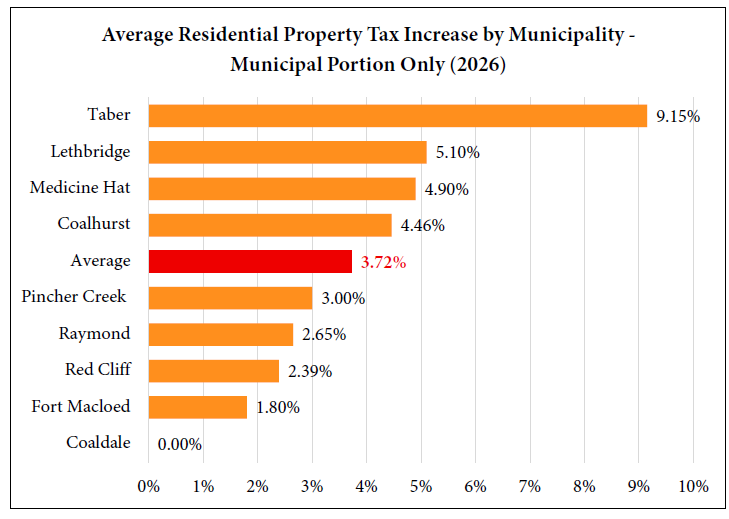
Residents across the province are also facing significant increases in Government of Alberta requisitions, including the provincial education requisition, which is increasing from $3.1 billion in 2025–26 to $3.6 billion in 2026–27. As a result, homeowners in some of Coaldale’s neighbouring municipalities are facing increases on both the municipal and provincial portions of their property tax bills. In the City of Lethbridge, for instance, the average homeowner will see a 5.1% increase in their municipal property taxes and a 12.9% increase in their provincial education property taxes. Similarly, in Taber the average homeowner will see a 9.15% increase in their municipal property taxes and a 10.5% increase in their provincial education property taxes.
When taken into account, Council’s decision to hold the line on the municipal portion of residential property taxes becomes all the more important – and all the more impressive.
“Although Coaldale homeowners are themselves facing a significant increase in their provincial education property taxes, Council’s decision ensures the Town is not adding to those pressures through an increase in municipal residential property taxes,” said Van Rijn. “Provincial requisitions for education and seniors’ housing are not set or controlled by municipalities, but what we can control is the municipal portion of the tax bill. By approving a 0% net increase in residential property taxes, we are doing what we can at the local level to protect affordability for residents.”
On the non-residential side of the equation, meanwhile, Council’s decision to maintain Coaldale’s non-residential property tax rate at $10 for every $1,000 in assessed value will help ensure that Coaldale remains a competitive place to invest, grow, and do business. By comparison, businesses in neighbouring Taber will pay just over $11 for every $1,000 in assessed value, or about 10% more than they would in Coaldale. In neighbouring Lethbridge, however, that difference is even more significant: in 2026, the City’s non-residential property tax rate will increase to $21.59 for every $1,000 in assessed value, meaning businesses there will pay approximately 116% more than they would in Coaldale.
“As a Council, we were also very clear during budget deliberations that we wanted to keep Coaldale competitive for businesses and investors,” said Van Rijn. “By holding the non-residential rate steady, we are providing cost certainty for local businesses while strengthening Coaldale’s position as one of the most competitive communities in the region for commercial and industrial investment. It’s not a 0% net increase, but it protects our competitive advantage and that’s the point.”